Friday, April 26, 2024

10 Surprising Jewish Facts That Will Delight and Distract You

 10 Surprising Jewish Facts That Will Delight and Distract You

By Maddy AlbertNov 5, 2020


With all that’s happening in the country and the world this week, we all need some distraction. One of my favorite ways to forget about the chaos of the present is to learn fun facts about the past. Nerdy? Perhaps. But interesting? You bet!

Fortunately, perusing the archives of Jewniverse — a collection of fun and sometimes shocking dispatches about Jewish culture, tradition, and history, published by our partner site, the Jewish Telegraphic Agency — has been an excellent exercise in anxiety reduction. As I fell down the Jewniverse rabbit hole, I found myself delighted by everything from the Jewish history of the Crock-Pot, to Betty Boop’s Jewish background, to the existence of a  tampon brand in Japan named for Anne Frank. (I kinda wish I was joking about that last one.)

If you need a brain break today — or anytime, really —  check out these 10 uplifting and surprising Jewish tidbits I’ve recently discovered. And if you’d like more offbeat Jewish gems like these, be sure to sign up for Jewniverse’s weekly newsletter here.

1. Three Jewish women have been crowned Miss India.

While the Jewish population in India numbers roughly 4,600, a teensy sliver of the country’s total population of some 1.38 billion, there have been multiple Jewish winners of the Miss India beauty pageant. Esther Victoria Abraham — better known by her stage name, Miss Pramila — won the first-ever Miss India pageant in 1947. Later, the crown was given to Jewish model Fleur Ezekiel in 1959 — she then went on to represent India in the Miss World pageant — and dancer Salome Aaron, the daughter of a Jewish couple credited with bringing the samba to India, won the title in 1972. Mazel tov!

2. There was actually a fish called the jewfish.

Yes, it certainly sounds vaguely antisemitic, but the origins of this Atlantic saltwater grouper’s name is a bit of a mystery. Some theories include that it evolved from the Italian “giupesce” (“bottom fish”), or that it’s a mispronunciation of “jawfish” because of the fish’s large mouth. Today, however, the jewfish is no more. While this fish still swims our waters today, after complaints of cultural insensitivity, its name was officially changed to the goliath grouper in 2001.

3. Seinfeld caused Nancy Sinatra to miss the death of her father.

On the afternoon of Frank Sinatra’s death, his daughter, Nancy, was preoccupied — watching the series finale of Seinfeld. Nancy Sinatra had planned to visit her father — he lived only five blocks away —  but she got sucked into the highly-anticipated finale, learning he had suffered a heart attack only after he had died. Nancy has since described the ordeal as her “greatest sadness,” and the news is all the more devastating considering that the series finale was panned by just about everyone, including Jerry Seinfeld himself.

4. Hank Greenberg fought racism in baseball.

Hank Greenberg wasn’t just one of the first prominent Jewish players in Major League Baseball — his legacy also includes making waves as a manager. Greenberg chose players for his team based on talent, taking no account of race. His team, the Cleveland Indians, won the American League pennant in 1954 under his management, and it happened to have more Black players than any other team in the league at that time. Greenberg is also known to be one of the first players outside the Brooklyn Dodgers to publicly welcome Jackie Robinson to the league.

5. Portuguese Jews invented fish & chips.

Fish and chips is considered a classic English dish, but its origins may surprise you. It turns out that Jewish refugees from Portugal actually brought the dish to England in the early 16th century; the delicacy is based on a Sephardic dish, pescado frito, or fried fish. Fish and chips were popularized in England by another Jew, Joseph Malin, who opened the first chippy in London in 1860.

6. Louis Comfort Tiffany designed Judaica.

Louis Comfort Tiffany may be most famous for his stained-glass lamp designs, but the artist also was responsible for numerous Jewish-themed stained-glass windows and mosaics. These jewel-toned creations were commissioned for synagogues and Jewish cemeteries throughout the 19th and 20th centuries. Perceived by some as an effort toward both assimilation and/or Jewish pride, the designs can still be viewed in a number of Jewish sites today, including Temple Emanu-El in New York City’s Upper East Side.

7. An Iranian official in France created a fake religion — saving Jewish families from the Nazis.

In France in the 1940s, the Iranian Consul, Abdol Hossein-Sardari, did something extraordinary: In an effort to save Iranian Jews from the Nazis, he invented a fake religion, Mosaique. “Some of the sixteen million Iranians…are converts to the Mosaique faith,” he said. “…They are descendants of the Aryan Indo-European race, with no relationship to the European Jewish race.” Using the Nazi’s bureaucracy against them, Hossein-Sardari reclassified 100 Iranian Jewish families and secured their deportation, likely saving their lives. This generous and creative act earned him a reputation as the “Schindler of Iran.”

8. Bob Dylan learned to play guitar at Jewish sleepaway camp.

Robert Zimmerman — later known as Bob Dylan — spent his childhood summers at Hertzl Camp, a Zionist sleepaway camp in Webster, Wisconsin. According to some stories, that’s where the young bard penned some of his first lyrics, as well as learned to play the guitar, harmonica, and piano. Dylan returned to the camp in the late 1970s when his son was a camper there.

9. Mr. Potato Head was invented by Jews.

Henry, Herman, and Hillel Hassenfeld, later known as the founders of Hasbro, sold the first Mr. Potato head facial parts kit after seeing potential in the invention by George Lerner, a Jew of Romanian descent. While the kit originally recommended that kids use real fruits and vegetables, Hasbro invented a plastic potato head in 1964 after receiving complaints from parents about rotten produce. Yuck!

10. Albert Einstein was a civil rights activist.

Though he was well-known for his Zionism, Jewish theoretical physicist Albert Einstein was also outspoken against racism throughout his career. After receiving an award from Lincoln University in 1946, Einstein spoke out against racism and segregation, announcing that he “did not intend to be quiet” about racism, a “disease of white people.” He was also an ally to Black leaders at the time, serving as a character witness for W.E.B. DeBois and working with singer-turned-activist Paul Robeson on the American Crusade to End Lynching. What a mensch!

Header Image via JTA Jewniverse Article Archive

Maddy Albert

Maddy Albert is the editorial assistant at Kveller.


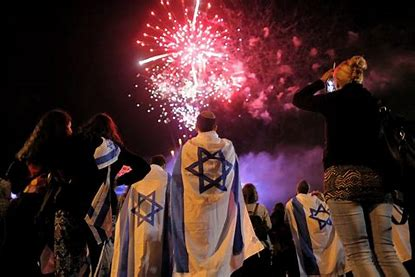
Yom Haszma’ut Israeli Independence Day, May 14, 2024

Yom Ha'atzmaut (Hebrew: יוֹם הָעַצְמָאוּת, lit. 'Day of Independence') is Israel's national day. It commemorates the Israeli Declaration of Independence on May 14, 1948, and is marked by various official and unofficial ceremonies and observances.


Because Israel declared independence on May 14, 1948, which corresponded with the 5th of Iyar on the Hebrew calendar, Yom Ha'atzmaut, originally celebrated on that date, ran into a religious conflict. To avoid Sabbath desecration, we may celebrate the holiday one or two days before or after the 5th of Iyar.


In the Hebrew calendar, days begin in the evening; Yom Ha'atzmaut is observed from nightfall until the following evening of the designated day.


History


David Ben-Gurion proclaiming independence beneath a large portrait of Theodor Herzl, founder of modern Zionism.

Israelis observe Yom Ha'atzmaut to commemorate the Israeli Declaration of Independence, which future Israeli Prime Minister David Ben-Gurion proclaimed on behalf of the Yishuv on May 14, 1948.] The mood outside of Ben-Gurion's residence just before the announcement was joyous:


The Jews of Palestine were dancing because they were about to realize what was the most remarkable and inspiring achievement in human history: A people that had been exiled from its homeland two thousand years before, which had endured countless pogroms, expulsions, and persecutions, but who had refused to relinquish its identity—which had, on the contrary, substantially strengthened that identity; a people who only a few years before had been the victim of humanity's most significant single act of mass murder, killing a third of the world's Jews, that people was returning home as sovereign citizens in their independent state.


Most countries refused concentration camp refugees,  including the U.S., until emergency legislation passed. Israel was the only country without restrictions for Jews.


The State of Israel was founded eight hours before the termination of the British Mandate for Palestine, which was due to finish on May 15, 1948.

Independence Day, 1978

The operative paragraph of the Declaration of the Establishment of the State of Israel of May 14, 1948, expresses the declaration to be by virtue of our natural and historic right and on the basis of the resolution of the United Nations General Assembly. The operative paragraph concludes with the words of Ben-Gurion, who declared the establishment of a Jewish state in Eretz, Israel, to be known as the State of Israel.


While Israel was quickly granted diplomatic recognition by many countries, including the Soviet Union and the United States, The Arab League, and most Muslim-majority countries resided in Israeli recognition. On May 15, Israel's neighboring Arab countries declared war on it. They invaded the territory of the former British Mandate, thus escalating the ongoing 1947–1948 civil war in Mandatory Palestine into the 1948 Arab–Israeli War. However, this war ended with an Israeli victory amidst the 1949 Armistice Agreements, which established the Green Line as Israel's international border.


Events

·        Independence Day celebrations in Tel Aviv's Rabin Square, 2008

·        Israeli Air Force Independence Day flypast, 2011

·        Eve of Independence Day

Memorial Day, or Yom Hazikaron, ends at sunset and is immediately followed by the onset of Independence Day. In the Hebrew calendar system, days end and begin at sunset.


An official ceremony is held annually on Mount Herzl, Jerusalem, on the evening of Independence Day. The ceremony includes a speech by the speaker of the Knesset (the Israeli Parliament), artistic performances, a Flag of Israel, forming elaborate structures (such as a Menorah Magen David), and the ceremonial lighting of twelve torches, one for each of the Tribes of Israel.


Religious Customs


Hallel recited at the Day to Praise Israel Independence Day event in Jerusalem on April 23, 2015

In response to widespread public feeling, the Chief Rabbinate in Israel decided in 1950–51 that Independence Day should gain the status of a minor Jewish holiday on which Hallel is recited. Their decision that it be recited (without a blessing) gave rise to a bitter public dispute, with Agudath Israel rejecting the notion of imbuing the day with any religious significance whatsoever and religious Zionists believing the blessing should be obligatory. The Rabbinate also ruled that they were "unable to sanction instrumental music and dances on this day which occurs during the sephirah period." The recitation of the blessing over Hallel was introduced in 1973 by Israeli Chief Rabbi Shlomo Goren. His Sephardic counterpart, Rabbi Ovadia Yosef and Rabbi Joseph B. Soloveitchik, leader of Modern Orthodox Judaism in America, strongly denounced the innovation.[19]


The Religious Zionist movement created a liturgy for the holiday, which sometimes includes the recitation of some psalms and the reading of the haftarah of Isaiah 10:32–12:6, which is also read on the last day of Pesach in the Diaspora on the holiday morning. Other changes to the daily prayers include reciting Hallel, saying the expanded Pesukei D'Zimrah of Shabbat (the same practice observed almost universally on Hoshanah Rabbah), and blowing the Shofar. Rabbi Joseph Soloveitchik questioned the Halachic imperative in canonizing these changes (it is unclear what his practice was regarding the recital of Hallel). In any case, most of his students recite Hallel without the blessings. Several authorities have promoted including a version of Al Hanisim (for the miracles) in the Amidah prayer.[22] In 2015, Koren Publishers Jerusalem published a machzor dedicated to the observance of Independence Day and Jerusalem Day.


Sabbath observance

Independence Day is rarely celebrated on the 5th of Iyar itself, and in most years, it is moved forward or backward by one or two days. According to the rules of the Jewish calendar explained in Days of Week on the Hebrew calendar, the 5th of Iyar can fall on a Monday, a Wednesday, a Friday, or a Saturday. To avoid Sabbath desecration, it was decided in 1951 that if the 5th of Iyar falls on a Friday or Saturday, the celebrations would be moved to the preceding Thursday (3 or 4 of Iyar). Additionally, since 2004, if the 5th of Iyar is on a Monday, the festival is postponed to Tuesday (6 of Iyar). 

Yom HaZikaron

 Yom HaZikaron (4 Iyur- May13,2024)


IDF soldiers participate in an official Yom HaZikaron ceremony for the fallen soldiers and the victims of terror attacks.


Yom HaZikaron (Hebrew: יוֹם הַזִּכָּרוֹן‎, lit. 'Memorial Day'), in full Yom HaZikaron LeHalelei Ma'arkhot Yisrael ul'Nifge'ei Pe'ulot HaEivah (Hebrew: יוֹם הזִּכָּרוֹן לְחַלְלֵי מַעַרְכוֹת יִשְׂרָאֵל וּלְנִפְגְעֵי פְּעֻלּוֹת הָאֵיבָה‎, lit. 'Memorial Day for the Fallen Soldiers of the Wars of Israel and Victims of Actions of Terrorism'), is Israel's official remembrance day, enacted into law in 1963. While Yom HaZikaron commemorates Israrel's fallen soldiers, commemoration has also been extended to civilian victims of terrorism.

History


An IDF officer places new flags, each with a black ribbon, on the graves of IDF soldiers for Yom HaZikaron.


IDF soldiers at a Yom HaZikaron ceremony in 2007


Bedouin Soldiers Memorial


In 1949 and 1950, the first two years after the state's declaration, memorial services for soldiers who fell in the War of Independence were held on Independence Day. The IDF and the Ministry of Defense coordinate services in military cemeteries.


Families of fallen soldiers expressed concern about establishing a separate Memorial Day observance distinct from the festive celebrations of national independence. In response, Prime Minister David Ben-Gurion—also serving as Minister of Defense—established in January 1951 the "Public Council for Soldiers' Commemoration." This council recommended establishing the 4th of Iyyar, the day preceding Independence Day, as the "General Memorial Day for the Heroes of the War of Independence." This proposal won government approval that same year.

In 2023, the Ministry of Diaspora Affairs and Combating Antisemitism announced a new policy that non-Israeli Jewish victims of antisemitic terror attacks outside of Israel should officially be mourned as part of each year's Yom HaZikaron commemoration to demonstrate solidarity with the Jewish diaspora

Observance

Yom HaZikaron is the national remembrance day observed in Israel for all Israeli military personnel who lost their lives in the struggle that led to the establishment of the State of Israel and for those who have been killed subsequently while on active duty in Israel's armed forces. As of Yom HaZikaron 2022, that number was 24,213.